When Thinking Becomes Optional
A sociological look at what is happening to how young people reason and why it should concern all of us

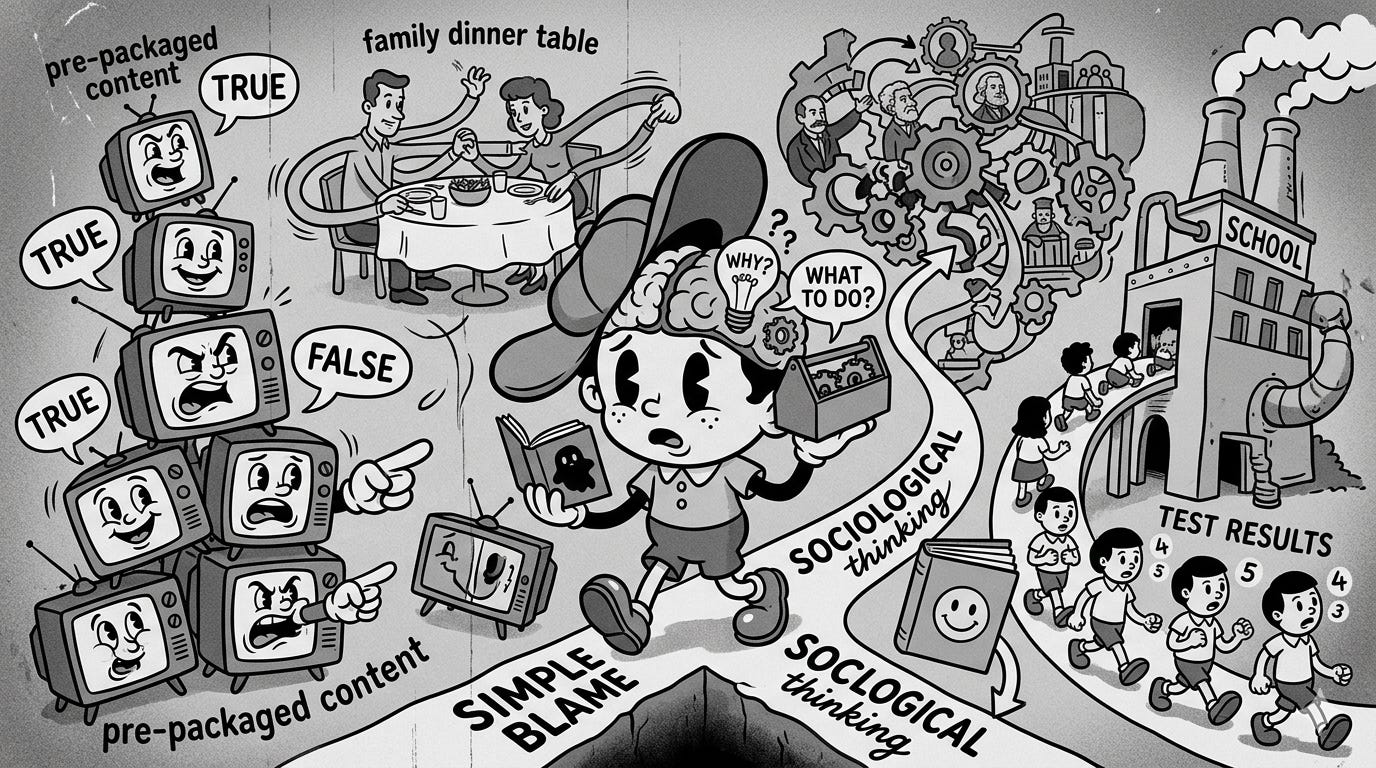
There is a particular conversation I keep noticing is harder to have than it used to be. Not arguments. Those are everywhere. But the slower, more uncertain kind of thinking-out-loud: the kind where a person holds two contradictory ideas at once, turns them over, and does not rush to resolve the tension. That capacity to sit with complexity, to ask why before asking what to do, is something we have long assumed children develop naturally, through schooling, through family dinner tables, through friction with the world. I am not sure we should keep assuming that.
This article grew out of a project I have been working on, a mail club for young readers, that started as a simple idea and gradually became something more diagnostic. Talking with children, watching what they engage with and what slides past them, I started wondering whether the difficulty I was noticing was individual, or structural. Whether it was always this way, or whether something has actually shifted. What follows is my attempt to think through that question carefully, without pretending I have a clean answer.
What we mean when we say critical thinking
It is worth being precise, because the phrase gets used loosely. Critical thinking is not the same as intelligence, and it is not the same as academic performance. A child can score well on standardised tests while being almost entirely passive in how they engage with information: accepting what they are told, sorting it into approved categories, and moving on. What we are talking about is something different. It is the habit of asking why a source says what it says, of noticing when a narrative has been shaped by someone with an interest in shaping it, of recognising that most important questions do not have single correct answers.
Sociological thinking adds a specific dimension: the ability to see individual experience inside a larger structure. To look at a family in difficulty and ask not only what went wrong in that family but what circumstances surrounded it. To look at a failing school and ask not only about its teachers but about the community, the economy, the history that produced it. This kind of thinking is uncomfortable, because it distributes responsibility in ways that feel less satisfying than simple blame. But it is also, historically, the kind of thinking that has driven every meaningful improvement in how societies organise themselves.
The media environment: content designed not to be thought about
The media young people consume today is not, on the whole, designed to invite reflection. It is designed to sustain attention. These are different things. Short-form video platforms, the primary information environment for children in their early teens, are optimised for emotional response and immediate gratification. The content that performs best on these platforms is conclusive: it tells you how to feel in the first three seconds, confirms rather than challenges, resolves rather than opens.
This is not the same as saying all short-form content is worthless. Some of it is good. But the architecture of the platforms, the scroll, the algorithm, the sheer volume, works against the cognitive posture that critical thinking requires. Thinking slowly takes time. It requires tolerating not knowing. A platform that rewards the fastest emotional response is training something, whether or not it means to.
There is also the specific problem of ideologically pre-packaged content: material that presents complex social questions as already resolved, where the correct position is assumed and the task is simply to affirm it. This exists across the political spectrum. Its effect on young people is not to make them more confident thinkers. It makes them better at recognising tribal signals, and worse at reasoning from evidence. The difference between those two things matters enormously.
The family: when time for slow conversation disappears
Long before school, and in parallel with it, families have been the primary environment where children learn to reason. Not through formal instruction but through conversation: the unhurried talk that happens around meals, during car journeys, in the ordinary stretches of shared time. These conversations are where children first encounter the experience of being taken seriously as a thinker, where an adult asks them what they think and then actually listens, where a question is followed not with an answer but with another question.
The conditions for this kind of conversation have been eroding for decades. Longer working hours, economic precarity, the logistical pressure of managing family life with fewer resources and less community support: these things do not just reduce the quantity of family time. They change its quality. Parents who are exhausted and stretched thin are less able to sustain the patient, open-ended conversations that build reasoning habits. This is not a moral failure by individual families. It is a structural condition that produces a predictable outcome.
Schools: teaching to measure, not to think
Education systems have long struggled with a basic tension: the things that matter most in a child’s intellectual development are also the things hardest to put a number on. Most have resolved this tension in the same direction, toward what can be tested, ranked, and reported.
India’s National Education Policy 2020 is an instructive case, not as a failure, but as a mirror. The document is serious and well-intentioned. It speaks directly about moving away from rote learning, about competency over content coverage, about nurturing curiosity as a goal in itself. These are the right instincts. But a policy document and a classroom are not the same thing, and the distance between NEP’s stated ambitions and what most children actually experience in school remains wide. Teachers are still assessed on results. Results still mean examinations. Examinations still reward recall. The language of the reform and the logic of the system pull in opposite directions, and the system, so far, is winning.
The problem runs deeper than implementation lag. Even where curricula have been revised, the things critical thinking most depends on remain hard to fit into a timetable: open-ended discussion, practice in identifying assumptions including one’s own, the willingness to sit with a question that has no clean answer. A student can pass a history exam without ever being asked what they think about what happened, or why it matters. What gets built instead is a certain performance: the ability to produce the expected response efficiently. Useful in a narrow sense. Not the same as learning to think.
What we do not teach: the omission of darkness from the preteen years
There is a subtler problem inside the curriculum problem, and I think it may be the most consequential one. Across subjects and age groups, but especially in the preteen years, there has been a sustained and largely unexamined drive to remove difficulty from what children encounter. Not difficulty in the sense of complexity or challenge, but difficulty in the sense of darkness: loss, failure, moral ambiguity, historical atrocity, the existence of suffering that does not resolve into a lesson.
Literature is the most visible place this shows up. The stories selected for younger readers are, with increasing regularity, stories where things work out. Where the villain is legible and the hero is clean. Where grief, if it appears, is brief and followed by healing. The older tradition of children’s literature understood something different: that stories which contain genuine darkness, the death of a beloved character, a wrong that is never righted, a good person who makes a terrible choice, do not traumatise children. They prepare them. They give a child their first safe encounter with the fact that the world does not always resolve itself in their favour, and that it is possible to survive that.
History taught to preteens is similarly laundered. Events like the Partition, the violence of colonial extraction, the lived reality of caste across generations: these appear, if at all, as dates and abstractions. The human texture is removed. A child learns that something called the Partition happened in 1947 and that it was bad, without ever being given the material to understand what it felt like to be inside it, what ordinary people did to each other, what it cost. This is not protection. It is a form of historical illiteracy dressed as care.
The consequence is not merely that children know less than they might. It is that they develop a relationship with reality that cannot accommodate difficulty. When something genuinely hard enters their lives, and it will, they have no prior practice in holding it. They have been raised on a version of the world that is tidier than the world actually is, and the gap between that version and experience is where a great deal of anxiety, rigidity, and intellectual passivity takes root.
I want to be careful here. None of this is an argument for exposing children to material that is beyond them, or for cruelty dressed as honesty. There is a real skill in calibrating what a ten-year-old can hold. But the current calibration in most curricula is not careful. It is anxious. And the result of anxious calibration is not protected children. It is children who reach adolescence without the imaginative resources to reason about a difficult world.
The pace of everything: why speed is an enemy of thought
There is something broader happening beyond any single institution. The general pace and texture of modern life, the density of information, the expectation of constant availability, the reward structures around speed and output, creates conditions that are systematically unfriendly to the kind of slow processing that deep thinking requires.
Children are growing up in this environment as their baseline. Boredom, which has historically been a precondition for imaginative and reflective thought, is increasingly engineered away. The experience of being unstimulated, of having to generate one’s own interest in the world, is being replaced by the experience of constant low-level input. We do not yet know the full cognitive consequences of this. But we do know that the ability to sustain attention, to tolerate uncertainty, and to work through complex problems over time are not qualities that develop in the absence of practice.
What we lose when a generation stops reasoning sociologically
Societies that struggle to think sociologically, to see their own conditions clearly, to identify how power works, to ask whose interests a given arrangement serves, tend to become easier to manipulate and harder to reform. This is not a new observation. What is different now is the speed and scale at which simplified narratives can be distributed, and the degree to which the media environments that young people inhabit are structured to reward consumption rather than interrogation.
The consequences are not only political, though the political ones are serious enough. They are also personal: a person who has not developed the habit of examining their own assumptions is more vulnerable to exploitation, more likely to repeat patterns they have not examined, and less able to navigate a world that will keep changing in ways no one has prepared them for.
None of this means the current generation is less capable than previous ones. That would be both condescending and probably wrong. What it means is that certain capacities, like any capacity, require conditions to develop in. And the conditions are not currently favourable.
What, then?
I want to be careful not to end this with false comfort. There are things that can be done: protecting unstructured time for conversation, restoring space in curricula for questions that do not have right answers, returning some of the darkness to the stories and histories we give children, building media literacy that goes beyond teaching children to spot fake headlines. None of this is impossible. There are schools doing it, families holding on to slower rhythms, communities that have not entirely surrendered to the pace.
But I am not sure any of that is sufficient at the scale of the problem. The forces involved, economic pressure on families, commercial incentives in media, the politics of education measurement, the velocity of technological change, are not easily redirected by individual effort or good intentions.
The more honest question, and the one I find myself unable to resolve, is this: if a society systematically undermines the conditions in which the next generation learns to think critically, what does it imagine will happen next? And does it imagine that at all?